
Selling Your House Yourself in Florida (For Sale by Owner)

Updated October 2026 · By Chris Romany, Founder of House Solutions USA · Buying houses in Central Florida since 2013
Table of Contents
The Short Answer
Yes, you can sell your house yourself in Florida. The state doesn’t require you to use an agent, and selling “by owner” (often called FSBO, short for For Sale by Owner) saves the commission you’d pay your own real estate agent. In exchange, you do the agent’s job: pricing the house, getting it in front of buyers, showing it, negotiating, and managing the paperwork until closing. It works best when the house is in good shape, priced right, and you have time to see the sale through.
This guide walks Central Florida homeowners in Orange, Seminole, Osceola, Polk and South Lake counties through the whole process: what you save, what you still pay, the forms Florida requires, and the one problem that sinks the most FSBO sales.
What You Save and What You Still Pay
What you save: the commission you’d pay your own real estate agent. Commissions are negotiable, so your savings depend on what an agent would have charged you.
What you may still pay:
- The buyer’s agent. Most buyers still shop with an agent. Since August 17, 2024, buyers sign a written agreement with their agent that sets how that agent is paid, and buyers can still ask the seller to pay it. Expect many offers to include that request.
- Your closing costs. In Florida, sellers customarily pay the state tax on the deed, called documentary stamp tax (70 cents per $100 of the price in most counties), and, in many counties, the owner’s title insurance policy. Both are negotiable.
- Getting the house online. Most buyers find homes on the websites real estate agents post to. Getting your house onto them without hiring an agent usually means paying a flat-fee service to post it for you.
- Monthly costs. Mortgage, insurance, utilities, HOA dues, taxes and lawn care keep running every month the house is for sale.
- Your time. Calls, showings, follow-ups and paperwork can take hours every week.
How to Sell Your House Yourself in Florida, Step by Step
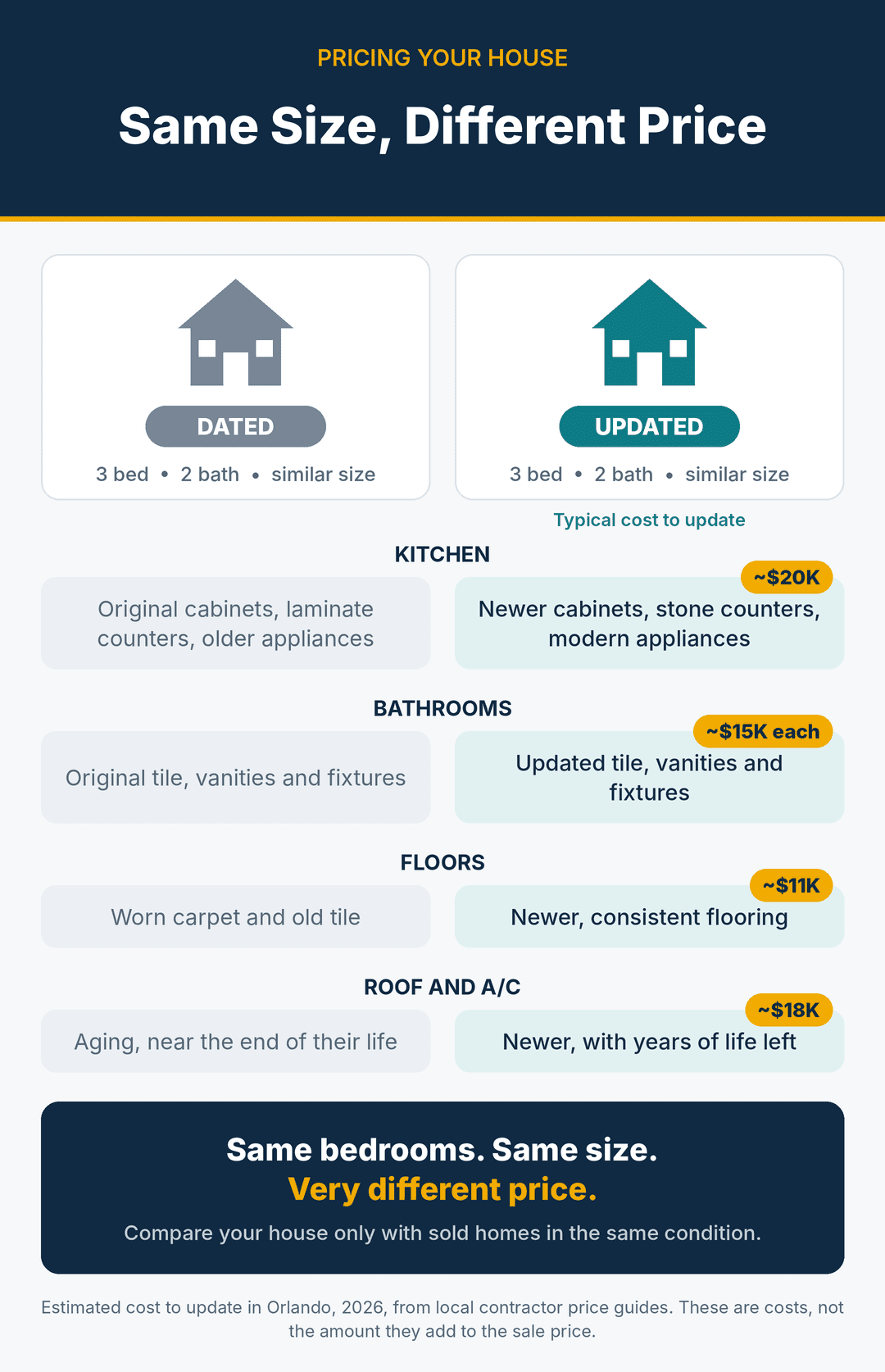
- Price it honestly, from recent sales of homes like yours. Look at nearby homes that actually sold in the last few months with the same number of bedrooms and bathrooms and about the same size. Online estimates are a waste of time: they’ve never seen the inside of your house, so they can’t tell a dated house from an updated one.
Then compare condition, because condition is what really sets the price:
- Kitchen: newer cabinets, stone counters and modern appliances, or the original cabinets and laminate counters?
- Bathrooms: updated tile, vanities and fixtures, or the ones the house was built with?
- Floors, roof and A/C: newer, or worn and near the end of their life?
Two houses with the same three bedrooms, two baths and square footage can sell for very different prices if one has been updated and the other hasn’t. Be honest with yourself about which one yours is, and compare it only with sold homes in similar condition. A dated house priced like an updated one sits on the market, and the longer it sits, the more buyers wonder what’s wrong with it.
- Get the house ready. Fix everything you reasonably can before the first showing: dripping faucets and leaks, broken doors and locks, cracked windows, holes in walls, loose handrails and burned-out bulbs. Every small problem makes a buyer wonder what bigger ones they can’t see. Skip big remodels, which take time and money you may not get back.
Then declutter. When you’re showing a house, less is more:
- Most buyers can’t see past clutter. Crowded counters, packed closets and too much furniture make rooms look smaller and hide the features you want buyers to notice.
- A messy house looks like a poorly maintained house, even when it isn’t. Buyers assume the roof, the A/C and the plumbing got the same care as the kitchen counters.
- Your house has competition. Buyers often tour several homes in a day and compare them afterward. The clean, open, bright one is the one they remember.
- Take down family photos and pack away anything with strong religious or political meaning. Buyers need to picture their own family living there. Personal items remind them they’re standing in someone else’s home, and anything that might put a buyer off is a risk you don’t need to take.
Pack what you won’t need before you move, clear the counters, thin out the closets, clean everything, and tidy the yard. First impressions start in the online photos and at the curb. - Take good photos and advertise. Photograph every room in daylight, plus the outside. If you can, pay a flat-fee service to post the house on the websites real estate agents use, and post it on the major home-search sites yourself. Add a For Sale yard sign that says “By Appointment Only.”
- Show it safely. Schedule every showing ahead of time, ask for the buyer’s name and phone number, lock away valuables and medications, and don’t show the house alone if you can avoid it.
- Ask every buyer for proof they can pay. Before you accept an offer, get a letter from the buyer’s lender saying the buyer has been approved for a loan (a “pre-approval letter”), or a bank statement showing a cash buyer has the money.
- Use the standard contract and the required notices. Most Florida sales use the Florida AS-IS contract, which you can read about on our FARBAR contract page. Florida law requires a radon gas notice on at least one document at or before the contract, and the standard form includes it. If the house was built before 1978, federal law requires a lead-based paint disclosure and gives the buyer 10 days to have it inspected. Tell the buyer about any problems you know of.
- Hire a title company. Send the signed contract to a local title company. It holds the buyer’s deposit, checks the public records to confirm you own the house, finds any liens (debts recorded against the house, such as a mortgage or unpaid taxes), prepares the closing papers and handles the money. Never wire money based on an email alone; call the title company at a number you know is real.
- Get through the inspection and appraisal. The buyer’s inspector will write up everything they find, and the buyer may ask for repairs or a lower price. If the buyer has a loan, the lender’s appraiser has to agree the house is worth the price.
- Close. You sign the deed at the title company, by mail or remotely if they allow it, and receive your money, usually the same day.
The Biggest Risk: A Buyer Whose Loan Falls Through
The problem that sinks the most FSBO sales isn’t the paperwork. It’s the buyer’s mortgage.
When you accept an offer from a buyer with a loan, your house comes off the market while the lender works. That can take about four to six weeks. During that time the lender orders an appraisal, checks the buyer’s income and credit, and decides whether to approve the loan. If the appraisal comes in low, the buyer may ask you to drop the price; if you refuse, the buyer can walk away from the sale. If the buyer loses a job, takes on new debt or simply doesn’t qualify, the loan is denied and the deal falls apart.
When that happens, you put the house back on the market and start the whole process over, after weeks of mortgage payments, utilities and waiting. An agent would face the same risk, but when you sell by owner, you’re the one who has to spot the warning signs and manage it.
How to lower the risk:
- Accept offers only with a pre-approval letter from a real lender, and call the lender to confirm it.
- Favor buyers with larger down payments, and give them less time in the contract to get their loan approved.
- Keep in touch with the buyer’s lender and the title company every week until closing.
- Consider a cash buyer, who has no loan to fall through.
When Selling It Yourself Isn't the Right Fit
Selling by owner makes the most sense when the house is in good shape, you have a few months, and you live nearby. It gets much harder when:
- The house needs major repairs. Buyers with loans need a house that passes inspection, appraisal and insurance. See our guide to selling a house that needs repairs.
- You’re on a deadline, such as a job move, a divorce or a house you can’t keep paying for. See how to sell a house fast in Central Florida.
- There are tenants in the house. Showings depend on their cooperation. See selling a house with tenants.
- You inherited the house or it’s in probate, and the family wants it handled without months of showings. See selling an inherited house.
- You live out of state and can’t be there for showings, inspections and repairs.
How House Solutions USA Helps
If you’d rather skip the advertising, the showings and the loan risk, you can sell directly to us. We have been buying houses in Central Florida since 2013, and buying houses is our full-time business. When you sell to us:
- We buy the house ourselves, with our own money, so there’s no loan to fall through.
- We see the house once and give you a written offer within 24 to 48 hours.
- You sell as-is. No repairs, no cleaning and no showings. Leave behind what you don’t want.
- We pay all closing costs and charge no fees and no commissions.
- You choose the closing date. We have closed in 7 days, and a typical sale takes about 21.
- You pay only what you already owe: your share of the property taxes, any HOA amounts owed and any liens against the house, paid from your sale money at closing.
Call 407-738-1581 or fill out our cash offer form. To compare every way to sell, read ways to sell a house fast in Central Florida. We buy houses in Orange County, Seminole County, Osceola County, Polk County and South Lake County.
Frequently Asked Questions
Can I sell my house without a realtor in Florida?
Yes. Florida doesn’t require you to use an agent to sell your own home. You handle the pricing, marketing, showings, negotiating and paperwork, and a title company handles the closing.
How much can I save by selling my house myself?
You save the commission you’d pay your own real estate agent, which is negotiable. You may still pay the buyer’s agent if the buyer asks, plus your closing costs, a service to post the house online and the costs of keeping the house until it sells.
What contract should I use to sell my house by owner in Florida?
Most Florida sales use the standard Florida AS-IS contract. You can read about it on our FARBAR contract page.
What disclosures do I need to give a buyer?
Florida requires a radon gas notice on at least one document at or before the contract. If the house was built before 1978, federal law requires a lead-based paint disclosure. Also tell the buyer about any problems you know of.
Do I need a title company or an attorney to sell my house myself?
Most Central Florida sales close through a title company, which holds the deposit, confirms you own the house, pays off any liens and prepares the closing papers. You can also hire a real estate attorney if you want one.
What happens if the buyer's loan falls through?
The sale usually ends, and you have to put the house back on the market. To lower the risk, accept offers only with a verified pre-approval letter, or sell to a cash buyer.
Do I pay a commission or fees when I sell to you?
No. There is no agent commission and no fee to us. We pay the closing costs. You pay what you already owe on the house, such as your share of property taxes, HOA amounts and any liens.