

Updated October 2026 · By Chris Romany, Founder of House Solutions USA · Buying houses in Central Florida since 2013
The Short Answer
Yes, you can sell a house while tenants are living in it, and in Florida the tenants do not have to move out for you to do it. A sale does not cancel a lease. The new owner steps into the landlord’s shoes, and a fixed-term lease generally continues until it ends. What changes is how you show the house, what happens to the security deposit, and how you handle the paperwork with your tenant.
This guide is for landlords in Orange, Seminole, Osceola, Polk and South Lake counties. It covers the steps to sell, the Florida rules that apply to showings, deposits and notices, what “cash for keys” is, and how to sell to a cash buyer who lets the tenants stay.
What Changes When Your House Has Tenants
Selling a house you live in is simple: you decide when buyers visit and when you move. With tenants, someone else lives there, and they have rights under their lease and Florida law. These are the usual trouble spots:
- Showings. Tenants may be at work, away or unwilling to open the door. Florida law says a tenant may not unreasonably withhold consent to the landlord showing the home to prospective buyers, but a tenant who is unhappy about the sale can still make every visit awkward.
- Condition. A house that is lived in is not always staged. Dishes in the sink, clutter and pets all show up in buyer photos and inspections.
- Worry. Tenants often fear a rent increase or an eviction notice. A tenant who feels left in the dark is the one most likely to cause trouble.
- Fewer buyers. Many buyers who plan to live in the house want it empty, which shrinks the pool of buyers while a lease is in place.
- Time. While the house is listed, you still carry the mortgage, insurance, taxes and repairs, and a vacant property carries its own risks.
How to Sell a House With Tenants in Florida, Step by Step
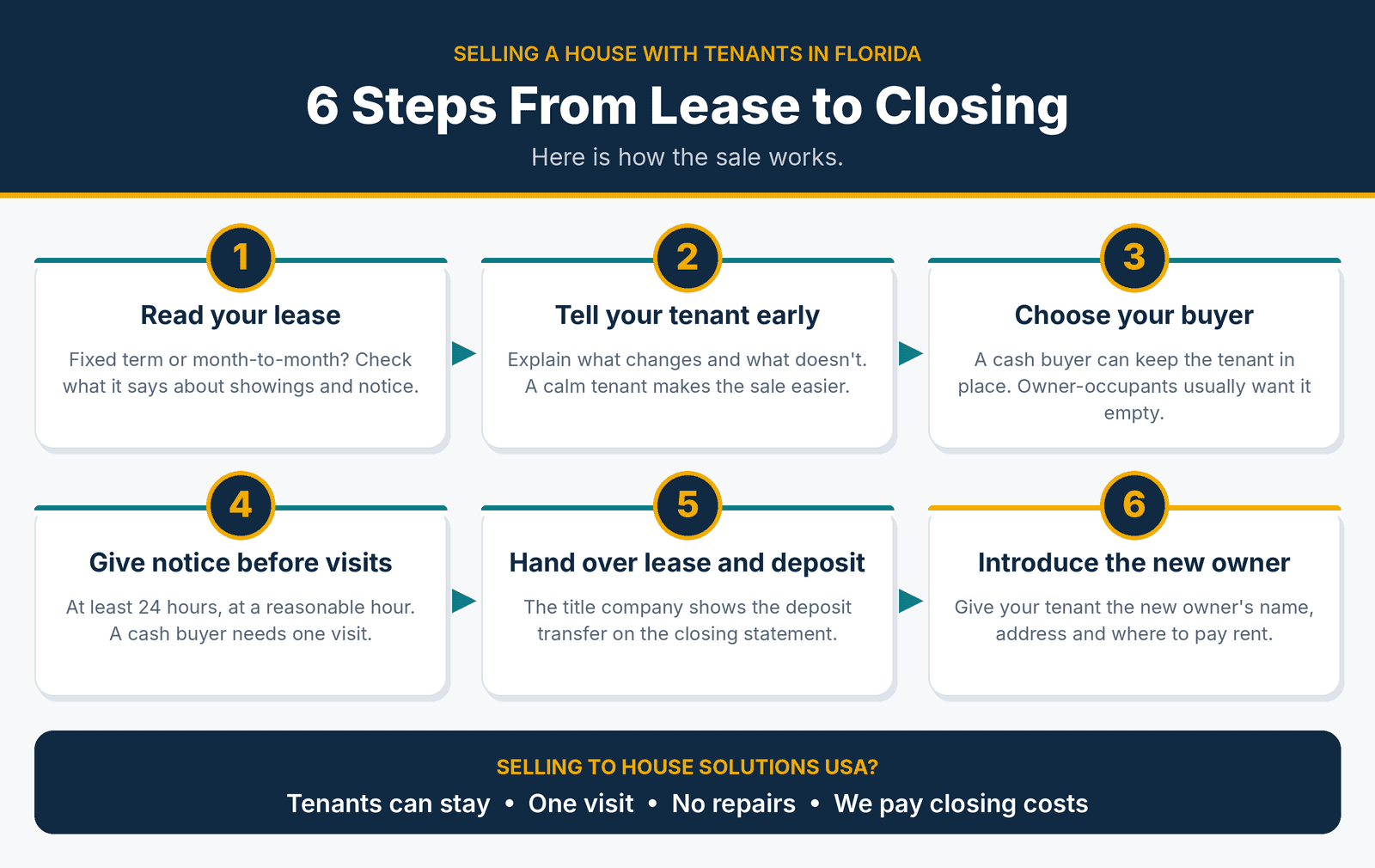
- Read your lease. Find out whether it is a fixed-term lease with an end date or a month-to-month tenancy, and look for anything it says about showings, notice or early termination. That decides your choices.
- Tell your tenant early. Explain that you plan to sell and what it means for them. If the buyer will keep the lease in place, say so. That removes most of the worry.
- Decide who you will sell to. A buyer who wants to live in the house usually wants it empty, so you would wait for the lease to end or reach a cash-for-keys agreement. An investor or a direct cash buyer like House Solutions USA buys with the tenant in place.
- Give notice before every visit. Florida law says a tenant may not unreasonably refuse showings. Give at least 24 hours’ notice and visit at a reasonable hour. A cash buyer needs one visit; a listing can need many.
- Sign the contract and plan the handover. The lease, the rent records and the security deposit go to the buyer. Your title company shows the deposit transfer on the closing statement.
- Close and tell your tenant who the new owner is. Give the tenant the new owner’s or manager’s name and address in writing, and where to send rent from now on.
The Florida rules behind each step are explained below.
The Florida Rules Every Landlord Should Know
These come from Florida’s landlord-tenant law, Chapter 83 of the Florida Statutes. Your lease may add its own terms, so read it before you act.
Does the lease survive the sale?
Generally, yes. A sale does not cancel a lease. The buyer becomes the new landlord and takes the house with the tenant’s lease in place, so a fixed-term lease usually runs to its end date. You cannot end a fixed-term lease early just because you sold the house, unless the lease itself or a lease violation allows it.
Showing the house
The law says a tenant may not unreasonably withhold consent for you to show the unit to prospective purchasers. It does not set a notice period for showings. The 24-hour notice it describes is for repairs, which are allowed between 7:30 a.m. and 8:00 p.m. Most landlords use the same standard for showings: at least 24 hours’ notice, at a reasonable hour, and check your lease for anything longer.
The security deposit
When the house changes hands, Florida law says the tenant’s security deposit and any advance rent must be transferred to the new owner, along with any interest earned and an accounting for each tenant. Once you transfer the money and get a written receipt, you are released from holding it. Your title company can handle this on the closing statement. The new owner then has to follow the state’s deposit rules, including the 15-day deadline to return the deposit or the 30-day deadline to send a notice if a claim will be made.
Telling your tenant
The landlord must give the tenant the name and address of the person who receives notices and rent. After a sale, that changes, so the tenant needs written notice of the new owner or manager, delivered to the tenant’s residence or sent by email as the law allows (Section 83.50). Tell your tenant early and plainly. A tenant who hears it from you is easier to work with than one who finds out from a stranger at the door.
Month-to-month tenants
If there is no fixed end date, either side can end the tenancy with written notice. Section 83.57 sets the minimum:
| Type of tenancy | Minimum written notice before the end of the period |
|---|---|
| Week to week | 7 days |
| Month to month | 30 days |
| Quarter to quarter | 30 days |
| Year to year | 60 days |
A buyer who wants the house empty can give a month-to-month tenant this notice after closing. A seller can give it before closing, but the notice must be in writing and given on time.
What "Cash for Keys" Means
Cash for keys is a payment you offer a tenant to move out early, usually by an agreed date and with the house left clean and in decent shape. It is voluntary: the tenant can say no, and then the lease stays in place. If the tenant says yes, put the deal in writing, with the move-out date, the amount, when it is paid and what condition the house must be in. A written agreement protects both of you.
It can make sense when the lease is nearly over, when the tenant already wants to leave, or when a vacant house is worth more to a buyer than an occupied one.
Selling Rental Property and Taxes: 1031 Exchanges
If the house is a rental you have held as an investment, you may be able to defer the tax on the gain by buying another investment property. The IRS calls this a like-kind exchange under Section 1031. The main rules:
- Both properties must be held for business or investment. A home you live in does not qualify.
- You have 45 days from the sale to identify replacement property in writing, and 180 days to complete the purchase.
- A qualified intermediary has to hold the sale proceeds. If you take the cash yourself before the exchange is complete, the whole exchange can be disqualified.
The timing is strict, so talk to your CPA and an intermediary before you sign a sale contract.
If you inherited the rental, see our guide to capital gains tax on inherited property.
How House Solutions USA Helps Landlords
We have been buying houses in Central Florida since 2013, and we are landlords ourselves, so we know what a tenant situation looks like from your side of the table. When you sell to us:
- Tenants can stay in the house during the sale. You don’t have to evict anyone or pay anyone to leave.
- We see the house once, at a time that works for your tenant, and you receive a written offer within 24 to 48 hours.
- You sell as-is. No repairs, no cleaning and no staging.
- We pay all closing costs and charge no fees and no commissions.
- You choose the closing date. We have closed in 7 days, and a typical sale takes about 21.
- You pay only what you already owe: your share of the property taxes, any HOA amounts owed and any liens against the house.
An honest note: if top price matters most and you can wait, listing the house may net you more. If you want to be done with it without disturbing your tenant, a direct cash sale is usually the simplest path.
Have your lease handy when you call. Call 407-738-1581 or fill out our cash offer form. To see every step, read how we buy houses. For the full picture of selling for cash, read Should I Sell My House Off Market for Cash?. We buy houses in Orange County, Seminole County, Osceola County, Polk County and South Lake County.
Frequently Asked Questions
Yes. The tenants don’t have to move out. A sale does not cancel the lease, and the new owner becomes the landlord. When you sell to us, your tenants can stay.
Tell them early. You need to give them written notice of the new owner’s name and address after the sale, and you will need their cooperation for showings. A tenant who is informed is easier to work with.
Not just because you are selling. A fixed-term lease generally continues unless the lease allows early termination or the tenant breaks it. A month-to-month tenancy can be ended with at least 30 days’ written notice before the end of a monthly period. Cash for keys is a voluntary alternative.
Not just because the house was sold. The new owner takes over the lease and must honor it until it ends. A month-to-month tenancy can be ended with at least 30 days’ written notice before the end of a monthly period. If a tenant stays after the tenancy ends, the owner has to go through the court eviction process; changing the locks or shutting off utilities is not allowed.
The deposit and any advance rent go to the new owner, with an accounting for each tenant. Your title company can handle the transfer at closing.
Yes, within reason. A tenant may not unreasonably withhold consent to showings, but the law doesn’t give a set notice period for them. Give at least 24 hours’ notice, and use the time your lease allows.
No. There is no agent commission and no fee to us. We pay the closing costs. You pay what you already owe on the house, such as your share of property taxes, HOA amounts and any liens.
About 21 days is typical for us, and the fastest was 7.
Share this article