
Updated September 2026 · By Chris Romany, Founder of House Solutions USA · Buying houses in Central Florida since 2013
The Short Answer
You can usually sell an inherited house in Florida before probate is finished. Who can sign the sale depends on how the house was titled and whether it was the owner’s homestead. Most sales need either a court-appointed personal representative or a court order naming the heirs. Once that authority is in place, a cash sale can close in as little as 7 days.
This guide walks through each step for heirs in Orange, Seminole, Osceola, Polk and South Lake counties, including heirs who live out of state.
In this guide
What Changed in 2026
- Florida’s small-estate limit doubled. Starting July 1, 2026, the simpler “summary administration” process is available when the estate’s non-exempt probate assets are worth $150,000 or less. The old limit was $75,000. Many families who were told they needed full probate may now qualify for the faster route. The protected homestead doesn’t count toward the limit.
- A property tax amendment is on the November 3, 2026 ballot. Amendment 3 would raise the homestead exemption for non-school taxes and lower the yearly assessment cap on non-homestead homes from 10% to 5%. It needs 60% of the vote and would take effect January 1, 2027. Until then, current property tax rules apply to every inherited house. We’ll update this page after the election.
Ownership and Probate
Step 1: Find out how the house was titled
The deed decides who owns the house now and whether probate is needed. You can look it up for free on the county Property Appraiser or Clerk of Court website.
| How the house was titled | Who owns it now | Probate needed? |
|---|---|---|
| In the owner’s name alone, with a will | The people named in the will | Yes |
| In the owner’s name alone, no will | Heirs set by Florida law | Yes |
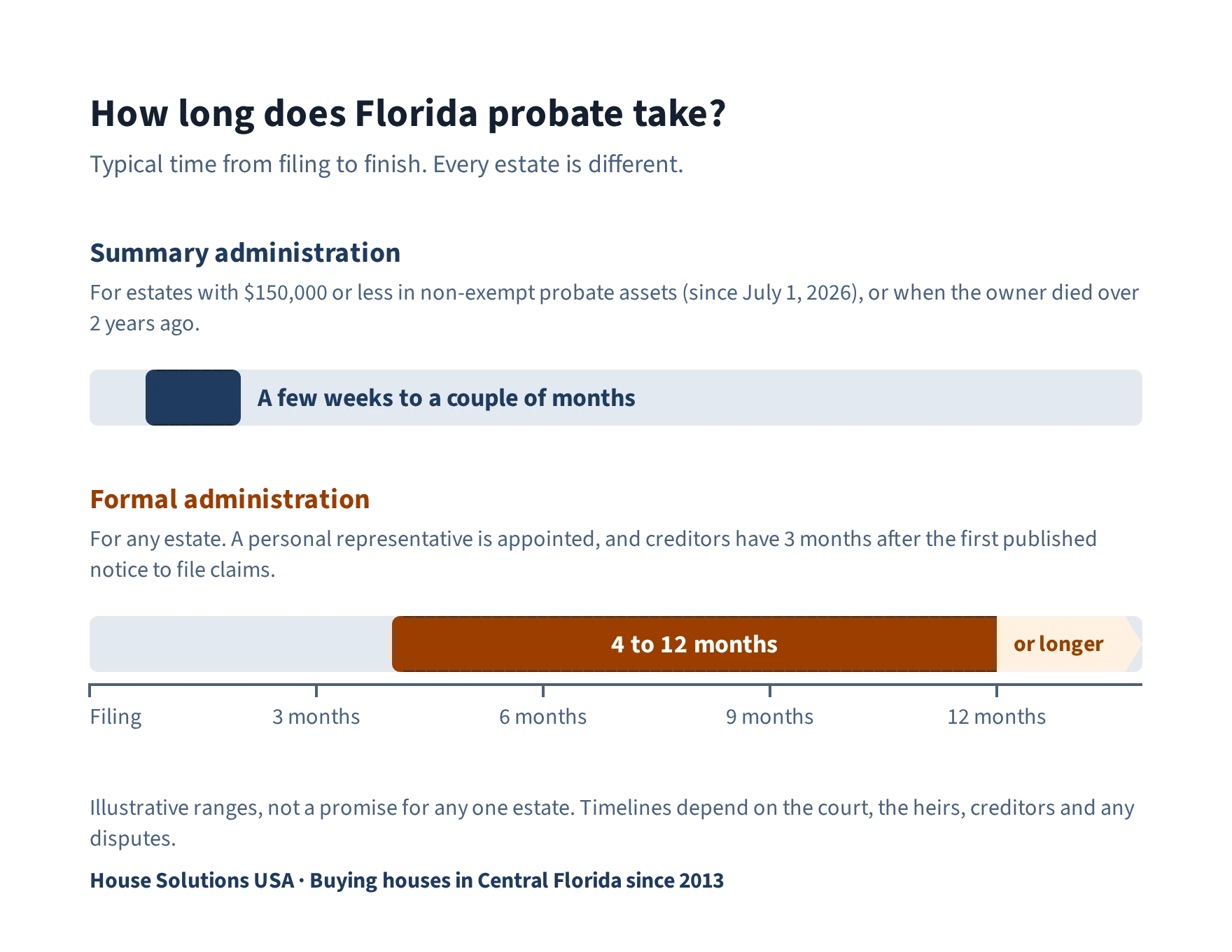
| Joint with right of survivorship, or a married couple as tenants by the entirety | The surviving owner | No. The survivor records the death certificate with the county. |
| Tenants in common | Each owner keeps their share; the deceased’s share passes through probate | Yes, for the deceased’s share |
| Living trust | The trustee, who can sell | No |
| Lady bird deed (enhanced life estate deed) | The beneficiaries named on the deed | No |
Step 2: Check whether it was a protected homestead
If the house was the owner’s permanent Florida residence, it is likely “protected homestead.” That status brings special rules:
- It passes outside the regular estate and is generally shielded from the estate’s creditors.
- The will may not control it. If the owner left a spouse or a minor child, Florida’s constitution limits who can inherit the home. When the owner leaves a spouse and children and the home wasn’t validly left to the spouse, the spouse gets a life estate and the children own the remainder. The spouse has 6 months after the death to choose a one-half ownership share instead.
- The court confirms it. A probate judge enters an order determining homestead status, naming who owns the house and in what shares. Title companies almost always require this order before a sale.
- Everyone with an interest signs. A sale needs every owner’s signature. If one owner is a minor, a court-supervised guardian signs for them, which adds time.
Step 3: Know which type of probate applies
Florida has two main types. The house’s value as protected homestead doesn’t count toward the summary limit.
| Summary administration | Formal administration | |
|---|---|---|
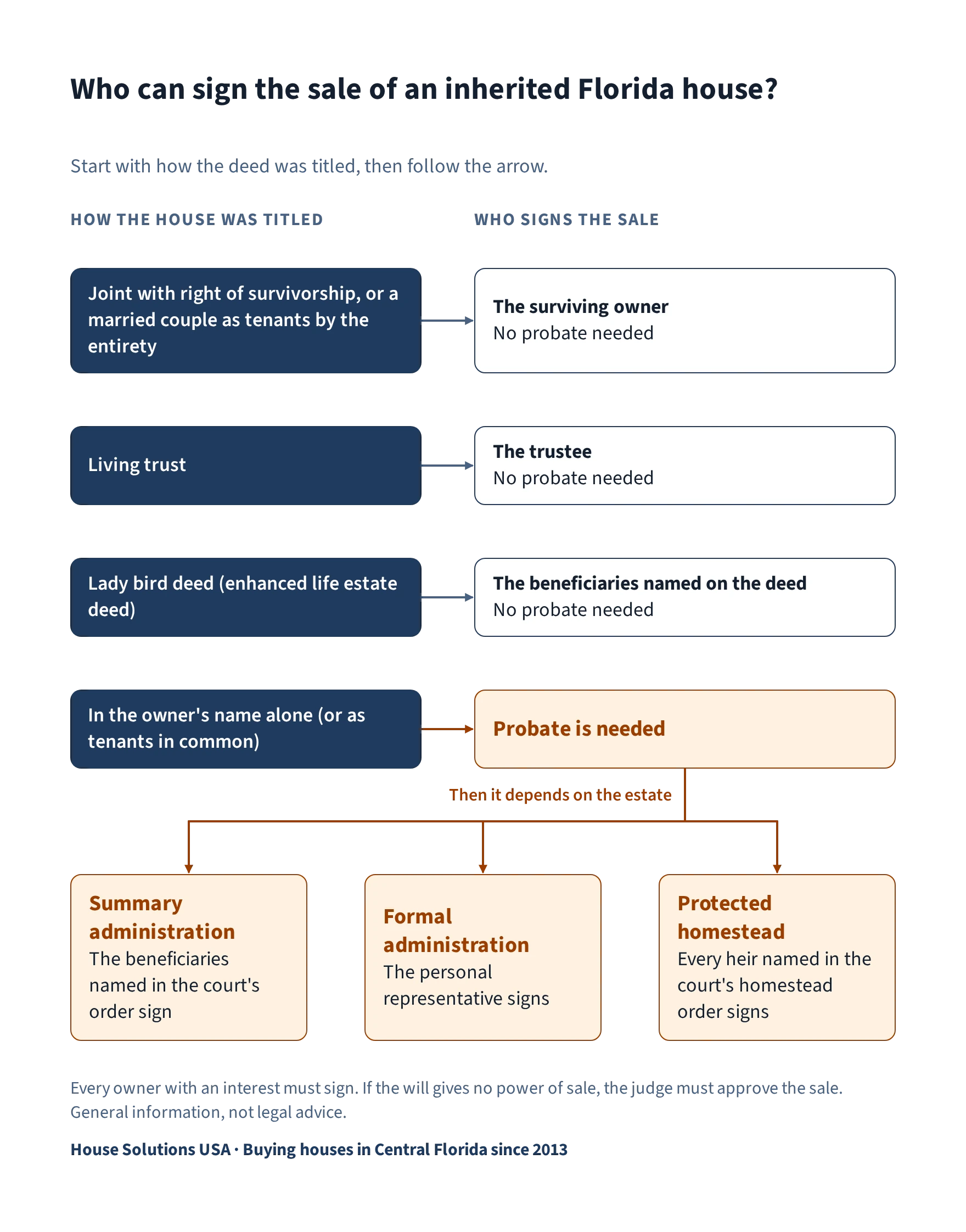
| When it’s available | Non-exempt probate assets of $150,000 or less (since July 1, 2026), or the owner died more than 2 years ago, and the will doesn’t require formal administration | Any estate |
| Personal representative appointed? | No. The court issues an order distributing the assets. | Yes. The court issues “letters of administration.” |
| Creditor protection | Limited | Creditors get 3 months after the first published notice to file claims |
| Typical timeline | Often a few weeks to a couple of months after filing | Often 6 to 12 months or longer |
| Who signs the house sale | The beneficiaries named in the court’s order | The personal representative |
What a probate attorney costs. Florida law sets a “presumed reasonable” fee for ordinary services in formal administration, based on the estate’s value. It is $1,500 up to $40,000, $3,000 at $100,000, then 3% of the next $900,000. For a $300,000 estate, that works out to $9,000. The fee is negotiable, and selling real estate can be billed as extra work.
Step 4: File probate in the right Central Florida county
Probate is filed in the county where the owner lived. If the owner lived out of state, a smaller “ancillary” probate is filed in the county where the Florida house sits.
| County | Clerk of Court (probate filing) | Judicial circuit |
|---|---|---|
| Orange | Orlando (Orange County Clerk probate page) | Ninth |
| Seminole | Sanford (Seminole County Clerk probate page) | Eighteenth |
| Osceola | Kissimmee (Osceola County Clerk probate page) | Ninth |
| Polk | Bartow (Polk County Clerk probate page) | Tenth |
| Lake | Tavares (Lake County Clerk probate page) | Fifth |
Selling, Costs and Taxes
Can you sell before probate is finished?
Yes, in most cases. You don’t have to wait for the estate to close. What you need is someone with legal authority to sign the deed:
- The will gives the personal representative a power of sale. The personal representative can sell without asking the judge first.
- There’s no will, or the will has no power of sale. The personal representative can still sign a contract, but the judge must approve the sale before it closes.
- Summary administration. Once the judge signs the order, the beneficiaries it names sign the deed.
- Protected homestead. Once the homestead order is entered, every heir it names signs the deed.
Selling from the estate often saves money. The house changes hands once instead of twice, and the sale money can pay estate expenses like attorney fees.
What it costs to hold an inherited house in Central Florida
Every month the house sits, the estate or the heirs keep paying for it. The big costs:
- Property taxes. Often reassessed at full market value on the next January 1. Exceptions: a surviving spouse or a dependent who lived there.
- Insurance can lapse or shrink. Tell the insurance company about the death right away. Many policies limit coverage once a home sits vacant, often after 30 to 60 days. Hurricane season runs June 1 through November 30.
- The mortgage still has to be paid. Federal law generally stops a lender from calling the loan due just because the home passed to a relative at death. The balance still must be paid, usually from the sale.
- Unpaid property taxes put the house at risk. Florida counties sell tax certificates on unpaid property taxes. The certificate holder can apply to sell the house at a tax deed auction in as little as two years.
- Utilities, lawn care, HOA dues and code enforcement continue as well. An overgrown yard on a vacant house can draw city or county fines.
Taxes when you sell
- Florida has no estate tax, inheritance tax or state income tax.
- Federal estate tax only affects very large estates, those above $15 million per person in 2026.
- Your tax starting point resets. For federal capital gains, the house’s value on the date of death becomes your “basis.” If you sell for about what it was worth then, you owe little or no capital gains tax.
- Any gain is taxed at long-term rates, even if you sell a week after inheriting. The IRS treats all inherited property as held for more than one year.
- Selling costs lower your taxable gain, including closing costs and any repairs that add value.
- Heirs outside Florida may owe income tax on the gain to their home state.
Get a date-of-death appraisal, or at least a written valuation, and keep it with your tax records. Talk to a CPA about your own situation before you sell.
Your Options and Special Situations
Before you list your property for sale, you will need to prepare it for potential buyers.
Your 3 ways to sell an inherited house
| List with an agent | Sell as-is to a cash buyer | Sell it yourself | |
|---|---|---|---|
| Repairs and cleanout | Usually needed for top price | None. Leave anything you don’t want. | Up to you |
| Time to close | Time on the market, plus 3 to 6 weeks for a buyer’s loan | As little as 7 days once someone has authority to sign | Varies |
| Main costs | Negotiable commission, repairs, months of holding costs | The offer is usually below a fully updated listing price | Marketing, legal help and your time |
| Best for | Updated homes; heirs with time and a repair budget | Dated or damaged homes, out-of-state heirs, tight deadlines | Heirs who have sold a home before |
A cash offer will usually be lower than what a fully renovated home might list for. What you get in return is speed, certainty and no repair bills. To compare fairly, look at what you’d net after commission, repairs and the months of taxes, insurance and utilities.
Selling an inherited Florida house from out of state
Many of the heirs we work with live in another state. Here’s what matters most:
- You may be able to serve as personal representative. A non-Floridian can serve only if closely related to the person who died. That includes a spouse, child, grandchild, parent, sibling, aunt, uncle, niece or nephew, or a descendant of one of these relatives. Otherwise the court appoints a Florida resident.
- Hire a probate attorney in the county where the case is filed. We’ve heard from out-of-state heirs who lost months by hiring a hometown attorney unfamiliar with Florida probate.
- You likely won’t need to fly in to close. Florida allows remote online notarization, and title companies routinely handle closings by mail.
- Someone local has to manage the house. That means securing it, keeping it insured, and handling the lawn and utilities. When you sell to us, we can take the keys, handle the cleanout and coordinate with your attorney.
Documents to gather: several certified death certificates, the will (if any), the deed, the latest property tax bill, the insurance policy, any mortgage statement, and your attorney’s contact information.
When the heirs don't agree
Disagreement is the biggest cause of delay we see, and it can cost the family the house. We once worked with a family whose home had housed three generations. It was sold at a tax deed auction because the heirs couldn’t agree on who should pay the property taxes.
- Decide early who pays the taxes and insurance, even if the estate reimburses them later.
- Get one written valuation that every heir sees, so no one is negotiating from a different number.
- Use a neutral third party, like the estate’s attorney or a mediator, when talks stall.
- Know the last resort. Any co-owner can ask a court to order the property sold through a partition lawsuit. It’s slow and expensive, which is usually reason enough to settle.
- If an heir is living in the house, consider whether they can buy out the others. We can also buy the house with an occupant in place and give them time to move.
How We Help, FAQs and Disclaimer
How House Solutions USA buys inherited houses
We’ve been buying houses in Central Florida since 2013, and inherited homes are a large share of what we buy. Here’s how it works:
- Call 407-738-1581 or fill out our cash offer form. Tell us about the house and where the estate stands.
- We look at the house once, usually at the first opportunity.
- You get a written offer on the standard Florida sales contract.
- Your attorney handles any court approval. We’re flexible on timing while probate moves forward.
- A local title company closes the sale. We pay the closing costs, you choose the closing date, and you can leave behind anything you don’t want to keep.
“Chris made the process of selling my Mom & Dad’s 58 year old house go seamless. He was professional, very knowledgeable and extremely helpful through the whole process. He was very fair in his offer on the house and gave us extra time needed to remove the contents in the house.” — John Morgan, Orlando
Read more from sellers on our reviews page.
Where we buy inherited houses: Orange County (Orlando, Winter Park, Apopka, Winter Garden, Windermere), Seminole County (Sanford, Lake Mary, Altamonte Springs, Oviedo, Winter Springs), Osceola County (Kissimmee, Saint Cloud, Poinciana), Polk County (Lakeland, Haines City, Davenport) and South Lake County (Clermont, Minneola).
Frequently asked questions
Usually, if the house was in the owner’s name alone. You don’t need probate if it was held in a living trust, passed by a lady bird deed, or was owned jointly with a survivor.
Summary administration often takes a few weeks to a couple of months. Formal administration usually takes 4 to 12 months or longer, depending on the heirs, creditors and any disputes.
$150,000 of non-exempt probate assets, effective July 1, 2026. It was $75,000 before. Summary administration is also available if the owner died more than two years ago.
Yes. The personal representative can sell once appointed, with court approval if the will doesn’t grant a power of sale.
Often little or none. Your basis is the home’s value on the date of death, and any gain is taxed at long-term rates. Florida has no state income tax.
Usually, yes. The home is typically reassessed at full market value on the next January 1, unless it passes to a surviving spouse or a dependent who lived there.
Yes. Most closings can be done by mail or remote online notarization.
Not if you sell to us. Take what matters to your family and leave the rest.
Keep making payments if you can until you sell. The mortgage is paid off from the sale proceeds at closing.
That heir can sometimes buy out the others. If not, we can often buy the house with them still living there and agree on a move-out date.
Florida’s presumed reasonable fee for formal administration is $3,000 for a $100,000 estate and $9,000 for a $300,000 estate. Fees are negotiable, and some attorneys offer flat fees. If you don’t have an attorney yet, give us a call. We can pay your attorney fees for you as part of the sale of the house.
This guide is general information for education purposes, not legal or tax advice. House Solutions USA is a home buyer, not a law firm. Talk to a Florida probate attorney and a CPA about your own situation.