

Updated October 2026 · By Chris Romany, Founder of House Solutions USA · Buying houses in Central Florida since 2013
The Short Answer
It depends on what matters most to you. Selling “off market” for cash means you sell your house directly to a buyer who pays without a mortgage, instead of listing it with an agent. You sell as-is, you skip showings, and the sale can close in as little as a week. The trade-off is price: a cash buyer needs room to make a profit, so an offer is usually lower than what a fully repaired house might bring on the open market.
Cash sales are common in Florida. Florida Realtors reports that 30.3% of closed single-family sales in the first quarter of 2026 were paid in cash. This guide explains how a cash sale works, what it costs, how to protect yourself from the wrong kind of buyer, and how to decide. It is written for homeowners in Orange, Seminole, Osceola, Polk and South Lake counties.
What "Off Market" Means
When a house sells on the market, an agent lists it, buyers tour it, and a buyer makes an offer. Most of those buyers need a mortgage, which means an appraisal, an inspection and a lender’s approval, and any of those steps can fall through.
When a house sells off the market, you sell directly to a buyer without listing it. With a cash buyer there is no loan to approve, no agent and no public marketing.
A cash buyer is usually an investor who plans to fix up the house and resell it, or keep it as a rental. That plan is why the offer is lower: the buyer takes on the repairs and the risk so you don’t have to.
How a Cash Sale Works With Us, Step by Step
- You contact us. Call 407-738-1581 or fill out our cash offer form with the address, a few details about the house and the date you’d like to sell.
- We research the house. We look at recent sales of similar homes, estimate the repairs and work out the as-is value. You get a written offer within 24 to 48 hours.
- We see the house once, at a time that suits you. You are never obligated to accept the offer.
- You sign the contract. We use the Florida AS-IS contract, the standard form created by Florida Realtors and the Florida Bar. You can read about it on our FARBAR contract page.
- A local title company prepares the closing. It searches the title, finds any liens, gets payoff letters and handles the paperwork.
- You close on the date you choose and collect your funds the same day.
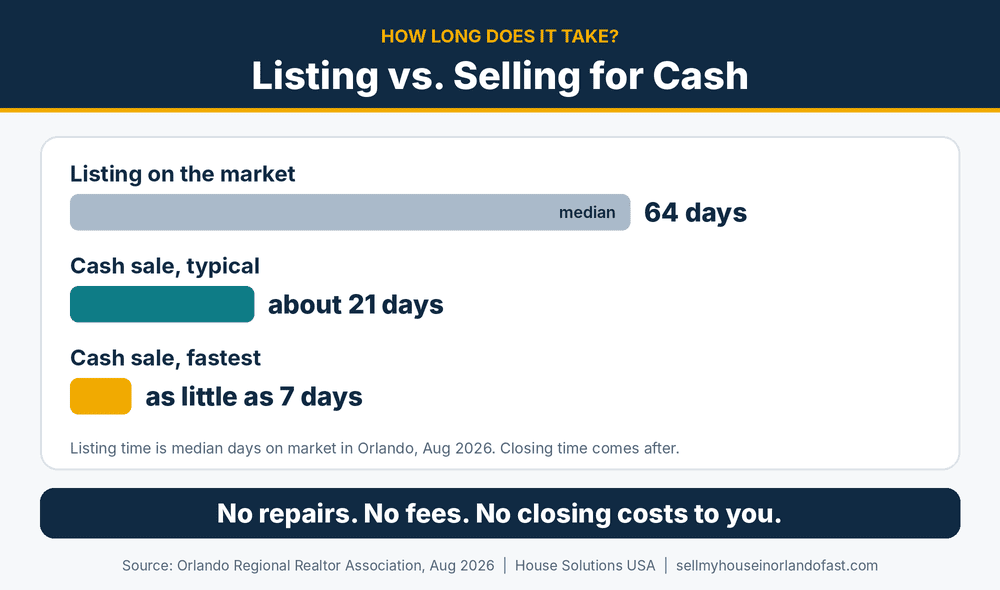
How fast? Our fastest closing was 7 days. A typical closing takes about 21 days. What can add time is not the buyer’s money but the paperwork: liens that take time to clear, an HOA that is slow to answer, or an estate that is waiting on the court.
What You Pay and What You Don't
| Listing with a Real Estate Agent | Cash sale with House Solutions USA | |
|---|---|---|
| Agent commission | Yes, a percentage of the price (negotiable) | None |
| Closing costs | Seller customarily pays some, such as the deed tax and often the owner’s title policy | We pay all closing costs |
| Repairs before the sale | Often needed to attract buyers | None, you sell as-is |
| Fees to us | Not applicable | None |
| Time you carry the house | Months are common | Typically about 3 weeks |
In Florida, sellers customarily pay the documentary stamp tax on the deed (70 cents per $100 of the price in most counties), and in many counties the owner’s title insurance policy and the agent’s commission. All of it is negotiable. In our cash sales, we pay the closing costs.
To compare any two offers, use one simple formula for each: the sale price, minus the agent commission, minus the closing costs you would pay, minus repairs, minus what it costs to keep the house until it sells (mortgage, insurance, utilities, HOA dues, taxes and lawn care). The offer with the larger number is the better one, whatever the headline price says.
What You Still Pay in a Cash Sale
A cash sale removes fees, but it doesn’t remove what you already owe on the house. These come out of your proceeds at closing:
- Your share of the property taxes. You pay for the days you owned the house. The title company works out the split. For the November bill and discount dates, see our guide to selling in December.
- HOA amounts owed. If the house is in a homeowners association, the HOA issues an estoppel certificate that shows what is owed. Florida law requires the association to deliver it within 10 business days after the request, or faster if you pay for expedited service. Ask for it early so it doesn’t hold up your closing date.
- Liens. A lien is a legal claim against the house for money owed. Mortgages, unpaid property taxes, HOA assessments, code enforcement fines, unpaid contractors and court judgments can all attach to a house. The title search finds them. The title company then gets a payoff amount from each lienholder and pays it from your proceeds, because clear title cannot pass to the buyer until every lien is paid or released.
You are not alone with these. Tell us what you know about them up front, and the title company handles the rest.
What "As-Is" Really Means
Selling as-is means you don’t have to repair, clean or paint anything. The buyer takes the house in its current condition. We even take anything you leave behind.
We look at the condition of the house ourselves and build it into our offer, so you don’t have to worry about what is wrong with it. If you know about a problem, such as a leaky roof or an old A/C, just mention it and we will factor it in.
How Fast Can You Sell? Cash vs. Listing
A listed house has to find a buyer first. Orlando Realtors reported an average of 64 days on the market in August 2026, and that is before the closing period that comes after a contract is signed. If the buyer needs a loan, the sale also depends on an appraisal and lender approval.
A cash sale skips most of that. We have closed in 7 days, and a typical sale takes about 21. You also pick the date, whether that means moving fast or having a few weeks to pack.
Is a Cash Sale Right for You?
It often fits when:
- You inherited a house you don’t want to keep up. Our guides cover selling an inherited house and selling a house in probate.
- The house needs repairs you can’t or don’t want to pay for.
- You have tenants, or you’re a tired landlord.
- You are going through a divorce and want to sell quickly so you can move on with your life.
- You are relocating or need to sell by a certain date.
- You are behind on payments, taxes or HOA dues and want to avoid a bigger problem.
It may not fit when:
- The house is in great shape and you can wait several months. Listing may bring a higher price.
- You have no deadline and want to test the open market first.
It costs nothing to compare. Get a cash offer, then compare it with what listing would net you using the formula above.
How to Spot a Trustworthy Cash Buyer
Not everyone who says “we buy houses for cash” is the same. Ask these questions before you sign anything:
- Will you buy the house yourself, with your own money? Some companies that advertise as cash buyers are middlemen. They sign a contract with you and then look for another investor to take over the deal. That is legal in Florida, but if they can’t find one, your sale can fall apart after you have waited weeks. A direct buyer closes the deal itself.
- Can you show proof of funds? A real cash buyer can show that the money is there.
- Do you charge any fees? A cash sale is a sale. You should not pay fees to sell your house to the buyer.
- Which contract will we use? Ask for the standard Florida AS-IS contract, not a custom contract written only to protect the buyer.
- Who closes the sale? A local title company that you can check.
- Is the offer in writing, with no pressure? Be careful with verbal promises, rushed deadlines and anyone who won’t let you take time to think.
- What do other sellers say? Look for reviews and years in business. You can read what our sellers say.
Documents to Have Ready
You don’t need all of these on day one, but they make the closing faster:
- Photo ID
- The deed, or other proof that you own the house
- If the owner has died, the court’s letters of administration (see our probate guide above)
- Your mortgage statement or lender’s contact, if there is a loan
- Your HOA’s name and contact information
- Your latest property tax bill
- Keys, garage door openers and gate codes
- Anything you know about repairs, roof or plumbing problems, and any lease if there are tenants
How House Solutions USA Helps
We have been buying houses in Central Florida since 2013, and buying houses is our full-time business. When you sell to us:
- We pay all closing costs and charge no fees and no commissions.
- You sell as-is. No repairs, no cleaning.
- We see the house once, and you receive a written offer within 24 to 48 hours.
- You choose the closing date. We have closed in 7 days, and a typical sale takes about 21.
- Tenants can stay in the house during the sale.
- You pay only what you already owe: your share of the property taxes, any amounts the HOA says are owed, and any liens against the house.
To see every step, read how we buy houses. We buy houses in Orange County, Seminole County, Osceola County, Polk County and South Lake County.