

Updated October 2026 · By Chris Romany, Founder of House Solutions USA · Buying houses in Central Florida since 2013
The Short Answer
Yes, you can sell a house in December in Central Florida, and you don’t have to wait for spring. Our weather doesn’t shut the market down the way snow does in the Northeast. What slows December is the calendar: holiday travel, family visits and buyers who put off their search until January. Orlando Realtors reported 2,182 closed sales in December 2025, so buyers are still out there. Homes simply take a while to sell, with an average of 78 days on the market.
This guide covers what really changes in December in Orange, Seminole, Osceola, Polk and South Lake counties, the costs to plan for, and your choices if you want to sell before the new year.
Does Our Weather Affect Home Sales in December?
Not much. Orlando’s December averages are a high of 73°F, a low of 55°F, and about 2.3 inches of rain over 8 rainy days, according to the 1991-2020 climate normals from the National Centers for Environmental Information. There is no snow, ice or frozen ground to get in the way of showings, inspections, appraisals or moving trucks.
Hurricane season is also behind us by then. NOAA says the Atlantic season runs from June 1 to November 30. Storms can still form outside those dates, but the season officially ends before December begins.
So if a northern website tells you December is a bad time to sell because of the weather, that advice doesn’t fit Central Florida.
What Does Slow Down in December
The slowdown here comes from people’s schedules, not the sky. Orlando Realtors’ own numbers show what that looks like:
- December 2025: 2,182 closed sales, 2,825 pending sales, 2,415 new listings and an average of 78 days on the market.
- January 2026: new listings jumped to 3,852, while closed sales fell to 1,634 (source: the same Orlando Realtors report).
- For comparison: the Orlando Realtors market narrative shows 2,720 sales in July 2026. That is a different year, so it is only a rough guide, but December closings ran roughly 20% lower.
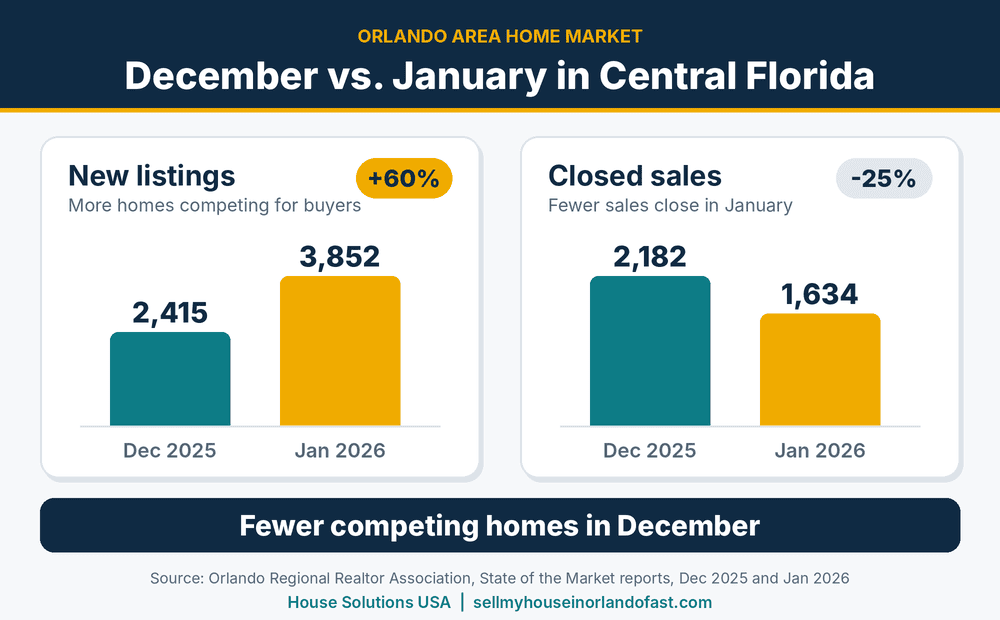
Two things stand out. December is slower, but it is not a dead month. And new listings rose about 60% from December to January, which means sellers who list in December face fewer competing homes than those who wait for the new-year wave.
The Real Problems With Selling in December (and Solutions)
Problem 1: Fewer showings and slower decisions
People travel and entertain, and many put house hunting on hold. With an average of 78 days on the market, a traditional listing can run well past New Year’s Day, and you keep paying the mortgage, insurance, utilities and any HOA dues the whole time.
Solutions: Price to the market as it is now, not to last summer’s sales. Make the house easy to show, with a lockbox and open showing windows. If time matters more than top dollar, a cash sale takes the waiting out of the picture (see the options table below).
Problem 2: Showings during the holidays
Picture family in town for the holidays, everyone around the table, and the phone rings. Your agent has a buyer who wants to see the house in an hour. With so few buyers out, you may feel you have to say yes. Selling the traditional way means opening your home to strangers again and again during the time of year you most want to be left alone.
Solution: Sell to a buyer who doesn’t need repeated showings. We typically visit the house once, at a time that suits you, and make our offer after that visit.
Problem 3: The property tax bill arrives in November
Florida property tax bills are mailed by November 1, and the full amount is due March 31. The Orange County Tax Collector lists a 4% discount for paying in November, 3% in December, 2% in January and 1% in February; taxes become delinquent on April 1. Check your own county’s tax collector for exact dates.
If you sell, taxes are normally split at closing so that you cover the days you owned the house and the buyer covers the rest. Your title company works out the numbers. Ask them how the proration will be handled if your closing falls near the date the new bill is issued.
Your Options for Selling in December
| List with an agent | Sell as-is to a cash buyer | Wait until January or spring | |
|---|---|---|---|
| Timing | Average of 78 days on the market in December 2025, then closing | You choose the closing date | Unknown; you carry the house in the meantime |
| Showings | Several, often at short notice | One visit | Same as listing now |
| Repairs | Often needed to attract buyers | Sell as-is | Often needed |
| Price | Open-market price, if a buyer appears | Usually below the open-market price of a fully repaired house | Open-market price, with more competing listings |
| Costs | Agent commission and closing costs | We pay the closing costs | Carrying costs continue |
A cash offer is usually lower than what a repaired, well-marketed house might bring on the open market. What you get in return is speed, certainty, no repairs and no showings. For many owners, especially those dealing with an inherited house, a tenant problem or a move, that trade is worth it. For others it isn’t, and it’s fine to compare both.
Four Tips if You Decide to List in December
- Price to current sales. Ask your agent for recent closed sales of similar homes, and ignore summer numbers.
- Be flexible on showings. A lockbox and wide showing windows catch the buyers who are in town for only a few days.
- Know your repairs. Fix or disclose anything a buyer’s inspector will find, so a deal doesn’t fall apart in the middle of the holidays.
- Plan for the tax bill. Decide whether you will pay it during the discount window or leave it to be settled at closing, and ask your title company which makes sense for your closing date.
How House Solutions USA Helps December Sellers
We have been buying houses in Central Florida since 2013, and buying houses is our full-time business, so it is the same in December as in July.
- Call 407-738-1581 or fill out our cash offer form. It takes about five minutes.
- We see the house once, at your convenience.
- You get a written offer on the standard Florida contract. You can read about it on our FARBAR contract page.
- A local title company closes the sale. We pay the closing costs, and you choose the closing date.
To see every step, read how we buy houses. We buy houses in Orange County, Seminole County, Osceola County, Polk County and South Lake County.
Frequently Asked Questions
It is slower than spring or summer, but it is not a bad time. Orlando Realtors recorded 2,182 closed sales in December 2025. Buyers are fewer and homes take longer to sell, but there is also less competition from other listings than in January.
Very little. Orlando’s December average high is 73°F with about 8 rainy days, so showings, inspections and closings go ahead as normal. The slowdown comes from holiday travel and schedules.
NOAA’s official Atlantic hurricane season runs June 1 through November 30. Storms can occasionally form outside those dates.
You owe taxes for the part of the year you owned the house. At closing, the title company splits the bill between you and the buyer. The new bill goes out by November 1, and the discount for paying in December is 3%, according to the Orange County Tax Collector.
When you sell to us, yes. The closing date is written into the contract. If the date matters for your taxes, ask a CPA before you agree to it.
That depends on how long you can afford to carry the house, and what could go wrong while you do. Waiting can bring more buyers, but new listings rose about 60% from December 2025 to January 2026, so you would also have more competition.
The bigger issue is risk. Every month you hold a house you plan to sell is another month of exposure to repairs on a property you don’t intend to own. Things can fail at any time, and a house that sits empty or is only visited now and then can make a small problem much bigger before anyone notices:
- Plumbing. A broken water line or a slow leak can soak floors, walls and cabinets, and in a vacant house it may run for days before anyone finds it.
- Air conditioning. In Central Florida the A/C runs most of the year. If it fails, you face a repair or replacement bill, and a house with no cooling can quickly develop humidity and mold problems.
- Roof and water intrusion. Our summer storms can find a weak spot in the roof, and a small leak left alone can damage the ceiling and insulation.
- Other systems. A water heater, appliance or electrical problem can show up in the middle of a listing and then has to be fixed or disclosed to the next buyer.
On top of repairs, the regular carrying costs keep running while you wait: mortgage, insurance, utilities, HOA dues, property taxes and lawn care. Add them up for the months you expect the house to sit, then add a cushion for one unexpected repair, and compare the total with what waiting might gain you.
If you would rather stop carrying that risk, selling as-is to a cash buyer moves it off your shoulders. We buy houses in their current condition, so a failed A/C or an old plumbing problem does not have to be fixed before closing.