
Selling a House During a Divorce in Florida: Your Options for the Marital Home
Updated October 2026 · By Chris Romany, Founder of House Solutions USA · Buying houses in Central Florida since 2013
The Short Answer
Yes, you can sell your house during a divorce in Florida, before or after the divorce is final. Most couples choose one of three paths: sell the house and split the money, have one spouse buy out the other, or keep owning it together for a while. If the house is marital property, Florida courts start from an equal split. If the house is your homestead, both spouses usually need to sign to sell it, even if only one name is on the deed. Selling often makes the most sense when neither of you can afford the house alone, or when you both want a clean break.
This guide explains your options, the Florida rules that affect a sale, how the money is usually divided, and how to sell without months of showings while you’re going through a divorce. It is written for homeowners in Orange, Seminole, Osceola, Polk and South Lake counties. Please note: this guide is for educational purposes only and is not legal advice. Every divorce is different, so always talk with your attorney before you make any decision about your house.
Your Three Options for the House
Option 1: Sell the house and split the money. The mortgage and selling costs are paid at closing, and the rest is divided the way your settlement or the judge decides. This is often the simplest path, especially when neither of you can afford the payments alone or you both want a fresh start.
- Good fit when: neither spouse can qualify for the mortgage alone, or you want to settle the house quickly.
- Watch out for: a long listing. Months of showings, repairs and price cuts are hard on anyone, and harder during a divorce. You also both keep paying for the house until it sells.
Option 2: One spouse buys out the other. One of you keeps the house and pays the other their share of the equity, usually by refinancing the mortgage into one name and taking cash out.
- Good fit when: one spouse wants to stay, often for the children, and can qualify for the loan on one income.
- Watch out for: the refinance. Taking your name off the deed does not take it off the mortgage. Until the loan is refinanced or paid off, both of you are still responsible for it, and a missed payment hurts both credit scores.
Option 3: Keep owning it together for now. Some couples agree to keep the house for a set time, for example until the youngest child finishes school, and then sell.
- Good fit when: you get along well enough to share decisions and costs.
- Watch out for: everything you still have to agree on later: who pays the mortgage, taxes, insurance and repairs, and when and how the house will be sold. Put it all in writing in your settlement agreement.
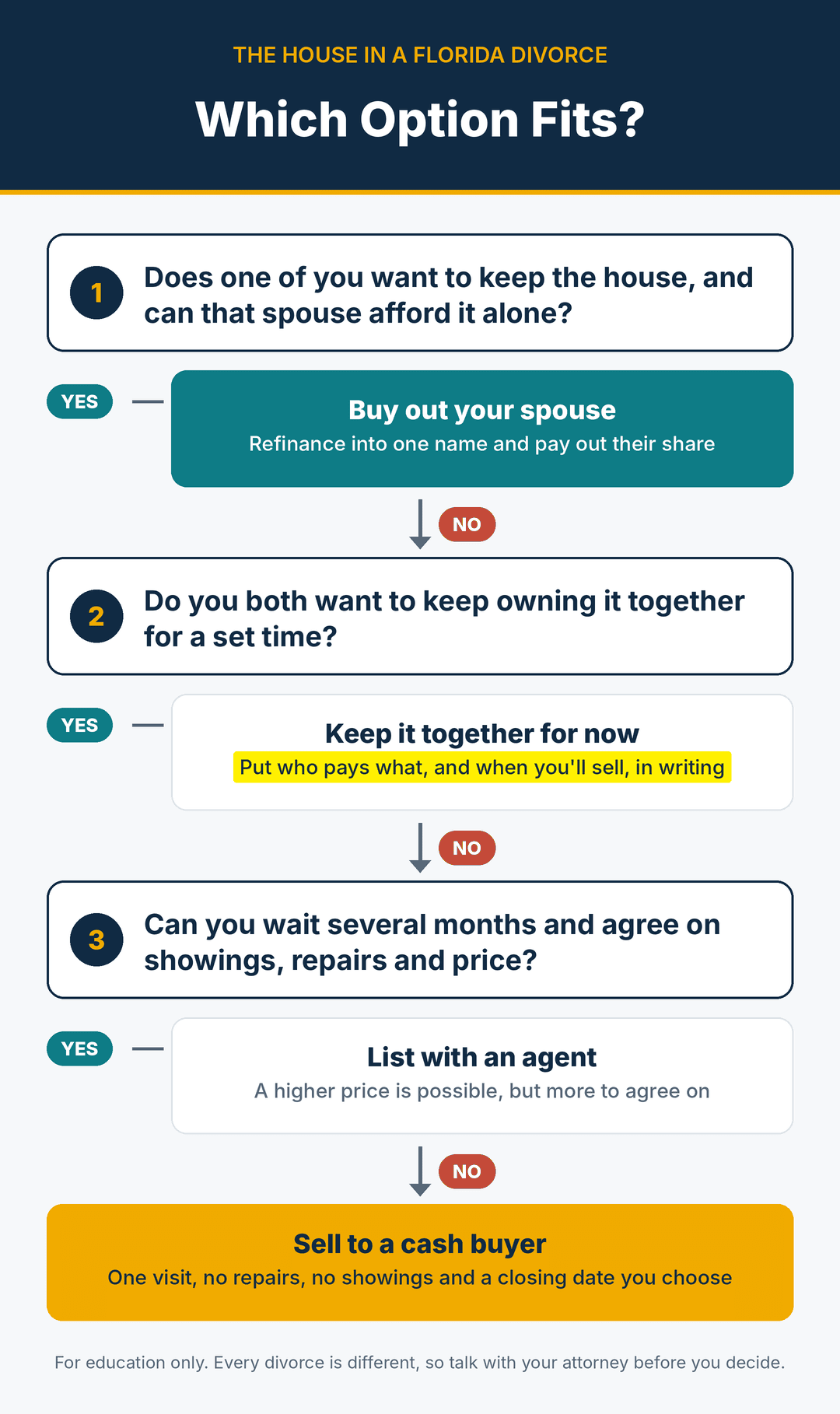
If you can’t agree, the court can decide. A judge can award the house to one spouse, give one spouse the right to live there for a set time, or order it sold. If former spouses still own a house together and can’t agree, either one can ask the court to order a sale. A sale you agree on yourselves is almost always faster and cheaper.
Florida Rules That Affect the Sale
Marital or not? Under Florida law, a house bought during the marriage is usually marital property, no matter whose name is on the deed. A house one spouse owned before the marriage is usually that spouse’s own property, but part of its value can become marital if marital money paid down the mortgage or the house went up in value because of either spouse’s work on it.
The split starts at 50/50. Florida divides marital property under “equitable distribution.” The court starts from an equal split and moves away from it only for a good reason, such as one spouse’s contributions or the children’s needs.
Both spouses usually have to sign. If the house is your homestead, Florida’s Constitution generally requires a married owner’s spouse to sign the deed to sell it, even if that spouse isn’t on the title. Once the divorce is final and the house has been awarded to one spouse, that spouse can usually sell alone. Your title company will check exactly who needs to sign.
The mortgage stays with whoever signed it. A divorce judgment doesn’t change your loan. The lender can still collect from everyone who signed the mortgage, whatever the judgment says, until the loan is refinanced or paid off at a sale.
Your attorney and the court have the final word. If your divorce case is already filed, check with your divorce attorney before you list the house or sign a contract. Your settlement agreement or a court order should say who can sign, how the money is split, and who pays the bills until closing.
How to Sell the House During a Divorce, Step by Step
- Agree on the plan in writing. Before you list or accept an offer, agree on the sale price you’ll accept, how the money will be split, who pays the mortgage and other bills until closing, and who stays in the house in the meantime. Put it in your settlement agreement or a written agreement your attorneys approve.
- Find out what you owe. Ask the lender for a payoff statement for every loan on the house, including any home equity line.
- Find out what the house is worth as-is. Compare it with recent sales of similar homes nearby in similar condition. Agreeing on repairs is hard during a divorce, so be realistic about the condition. Our guide to selling a house that needs repairs explains how condition affects price.
- Choose how to sell. Listing with an agent can bring a higher price but means months of showings, repairs, price decisions and back-and-forth that both of you have to agree on. A direct sale to a cash buyer is faster and simpler, with one visit, no repairs and a closing date you choose, but the price is usually lower. Our guide to ways to sell a house in Central Florida compares the options.
- Both sign the contract. If both of you own the house, or it’s your homestead, both of you sign the sale contract and, at closing, the deed.
- Close with a title company. The title company pays off the mortgage, any liens and the closing costs from the sale money. It can then pay each of you your share, or hold the money until your settlement or the court says how to divide it. Tell the title company early what your agreement says.
You don’t have to be in the same room. If you’d rather not see each other, the title company can usually have each spouse sign at a different time or place, including by mail or with a mobile notary.
Taxes and Money
The capital gains tax break. When you sell your main home, the IRS generally lets you exclude up to $250,000 of profit, or $500,000 if you’re married and file a joint return, as long as you owned the home and lived in it for at least 2 of the last 5 years. Divorce changes how this works:
- Selling while still married and filing jointly for that year can let you use the full $500,000 together.
- After the divorce, each of you generally gets up to $250,000 for your own share.
- If one spouse moves out, that spouse can usually still count the years the other spouse lived there under the divorce or separation agreement. The wording of that agreement matters, so make sure it covers this.
- If one spouse gets the house in the divorce, the transfer between spouses is generally not taxed, and the spouse who keeps it gets credit for the time the other spouse owned it.
The IRS Publication 523 explains these rules. Ask your CPA how they apply to you before you decide when to sell.
Costs while you wait. Until the house sells, someone has to pay the mortgage, insurance, property taxes, HOA dues, utilities and upkeep, and an empty house still costs money every month. If you list, the house also has to stay clean and ready for showings. Agree in writing on who pays what, and whether those payments are credited back when the money is divided.
How the money is split. The sale money left after the mortgage, liens and closing costs is divided the way your settlement agreement or the court decides. If one spouse paid more toward the house during the separation, that is often taken into account. Your attorney can tell you how it applies to you.
How House Solutions USA Helps
If you and your spouse decide to sell, you can sell directly to us and avoid months of showings and decisions you’d have to make together. We have been buying houses in Central Florida since 2013, and buying houses is our full-time business. When you sell to us:
- We buy the house ourselves, with our own money.
- We see the house once and give you a written offer within 24 to 48 hours. We can send the same offer to both of you, and to your attorneys.
- You sell as-is. No repairs, no cleaning and no showings, so there’s nothing more to agree on. Leave behind what you don’t want.
- You choose the closing date. We have closed in 7 days, and a typical sale takes about 21. If you’re waiting on a settlement or court order, we can set the closing date to match.
- We pay all closing costs and charge no fees and no commissions.
- The title company pays off the mortgage and any liens from the sale money at closing, and divides or holds the rest as your agreement or the court directs. Each of you can sign separately.
Call 407-738-1581 or fill out our cash offer form. If you need to sell quickly, read how to sell a house fast in Central Florida. To compare every way to sell, read ways to sell a house in Central Florida. We buy houses in Orange County, Seminole County, Osceola County, Polk County and South Lake County.
Frequently Asked Questions
Can I sell my house before my divorce is final in Florida?
Yes, if you and your spouse agree, or if the court orders it. If your case has already been filed, check with your divorce attorney first, and put the terms of the sale and how the money will be split in writing.
Who gets the house in a Florida divorce?
It depends. If the house is marital property, Florida courts start from an equal split of everything you own together. The house may be sold and the money divided, kept by one spouse who buys out the other, or kept by one spouse for a time, often for the children. Many couples decide this themselves in a settlement agreement.
Does my spouse have to sign to sell the house?
Usually, yes. If you both own the house, you both sign. If it’s your homestead, Florida generally requires a married owner’s spouse to sign the deed even if that spouse isn’t on the title. Once the divorce is final and the house has been awarded to one spouse, that spouse can usually sell alone.
If my spouse keeps the house, am I still on the mortgage?
Yes, until the loan is refinanced or paid off. Removing your name from the deed doesn’t remove it from the mortgage, and late payments can still hurt your credit.
Do we pay capital gains tax when we sell during a divorce?
Often not on most of the profit. Married couples filing jointly can generally exclude up to $500,000, and each person up to $250,000 after the divorce, if the ownership and use rules are met. A spouse who moved out may still qualify under the divorce agreement. Ask your CPA about your situation.
Do I pay a commission or fees when I sell to you?
No. There is no agent commission and no fee to us. We pay the closing costs. You pay what you already owe on the house, such as the mortgage payoff, your share of property taxes, HOA amounts and any liens, all from the sale money at closing.