

Updated October 2026 · By Chris Romany, Founder of House Solutions USA · Buying houses in Central Florida since 2013
The Short Answer
Yes, you can sell your house while it’s in foreclosure in Florida, and in most cases you can sell right up until the foreclosure auction. Florida foreclosures go through the court, so they take time: your lender generally can’t file until you’re more than 120 days behind, and the case usually takes many months after that. Selling before the auction lets you pay off the loan, keep any equity that’s left, and avoid having a foreclosure on your record.
The sooner you act, the more choices you have. This guide explains how foreclosure works in Florida, what your options are, how to sell before the auction date, and how to avoid the scams that target homeowners in foreclosure. It is written for homeowners in Orange, Seminole, Osceola, Polk and South Lake counties.
How Foreclosure Works in Florida, Step by Step
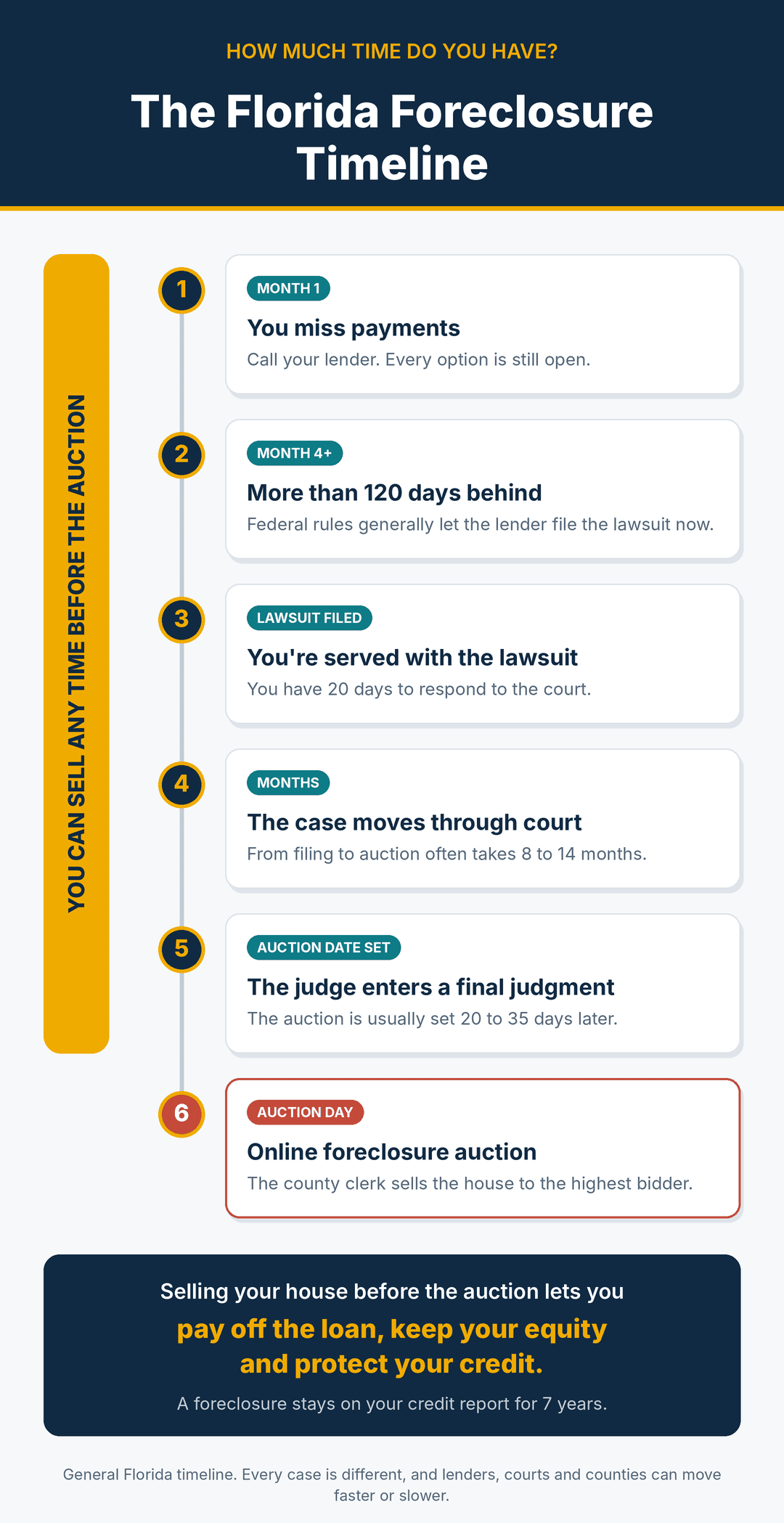
Florida is a “judicial foreclosure” state. That means your lender can’t simply take the house. It has to sue you in the county court, and a judge has to approve the foreclosure before the house can be sold. Here is the usual order of events:
- You miss payments. Your lender, or the company that collects your payments, will call and send letters. This is the best time to act, because every option is still open.
- You get a warning letter. Most mortgages require the lender to send a letter, often called a demand or breach letter, giving you a set time, usually 30 days, to catch up before it can move forward.
- The lender files a lawsuit. Under federal rules, most lenders can’t start the foreclosure until you are more than 120 days behind, according to the Consumer Financial Protection Bureau. The lawsuit is filed with the county Clerk of Court, and a notice of the case, called a lis pendens, is recorded against your house.
- You are served and have 20 days to respond. Someone hands you the court papers. If you don’t file a response, the lender can ask the court to rule against you without hearing your side.
- The judge enters a final judgment. This can take months. When it happens, the judgment sets the date of the foreclosure auction, which under Florida law is usually 20 to 35 days later.
- The house is sold at auction. In Central Florida, the county clerk holds these auctions online. The highest bidder wins, and if no one outbids the lender, the lender takes the house back.
- The auction becomes final. The clerk files a certificate of sale, usually the same day, and about 10 days later issues the title to the winning bidder. The new owner can then ask the court to have you removed.
How long does it take? From the lawsuit to the auction, Florida foreclosures commonly take about 8 to 14 months, and longer if you respond and the case is contested. Add the four months or more before the lender can file, and many homeowners have a year or more from the first missed payment. That time is valuable, but it goes faster than most people expect.
Foreclosures are rising in Florida. According to ATTOM, Florida had the highest foreclosure rate of any state in the first half of 2026, and the Lakeland area in Polk County had one of the highest rates of any metro area in the country. If you’re in this situation, you are far from alone.
Your Options if You're Behind on Your Mortgage
Which option fits depends on two things: whether you want to keep the house, and whether the house is worth more than you owe. Start by calling your lender and asking what they offer. You can also get free advice from a housing counselor approved by the U.S. Department of Housing and Urban Development (HUD), which you can find through the Consumer Financial Protection Bureau’s counselor search.
If you want to keep the house:
- Catch up on what you owe. You can usually stop the foreclosure by paying all missed payments plus fees, up until the auction.
- A repayment plan. The lender adds part of what you owe to your regular payment until you’re caught up.
- A forbearance. The lender lowers or pauses your payments for a short time, often after a job loss or illness. You still have to pay the money back later.
- A loan modification. The lender permanently changes the loan, for example by lowering the rate or stretching out the term, so the payment is easier to afford. Apply early. Under federal rules, if you send a complete application more than 37 days before the auction date, the lender generally can’t go ahead with the auction until it has reviewed it.
- Bankruptcy. Filing for bankruptcy pauses the foreclosure, but it has long-term effects on your credit. Talk with a bankruptcy attorney before you decide.
If you’re ready to move on:
- Sell the house. If the house is worth more than you owe, selling pays off the loan and puts the rest of the money in your pocket. This is usually the best way out, and the next section explains how.
- A short sale. If you owe more than the house is worth, the lender may agree to accept less than the full balance. Short sales need the lender’s written approval, which can take months, and the lender may still come after you for the difference unless it agrees in writing to waive it.
- A deed in lieu of foreclosure. You sign the house over to the lender in exchange for it dropping the foreclosure. You walk away with nothing, but you avoid the court process.
The worst choice is doing nothing. At auction, you have no control over the price, and bids often come in below what the house would sell for on the open market. The lender’s legal fees and interest keep adding to what you owe, and other liens are paid before you. Any money left over is yours, but you have to claim it from the county clerk, and it’s usually less than you’d have received by selling the house yourself. The foreclosure also stays on your credit report for seven years, and if the auction doesn’t bring in enough to cover what you owe, Florida law gives the lender up to one year to sue you for the difference.
How to Sell Your House Before the Foreclosure Auction
You still own the house until the foreclosure auction, so you can sell it like any other house. The lender is paid off at closing, and the case ends.
- Find out what you owe. Ask your lender for a payoff statement, the exact amount needed to pay off the loan on a given date. In a foreclosure, it includes the missed payments, late fees, interest and the lender’s legal costs, so it is usually more than your regular loan balance.
- Find out what the house is worth as-is. Compare it with recent sales of similar homes nearby in similar condition. If the house needs work, be realistic. Our guide to selling a house that needs repairs explains how condition affects price.
- Check the calendar. If an auction date has already been set, every week counts. Listing with an agent takes time: homes in the Orlando area averaged more than two months on the market in 2026, and a buyer’s loan then needs another 30 to 45 days to close. A cash buyer can close in one to three weeks.
- Sign a contract and tell your lender. Send the lender a copy of the contract and ask whether it will postpone the auction to let you close. Lenders often agree, because your sale pays them in full, but they don’t have to, so don’t count on it.
- Close with a title company. The title company pays off the mortgage and any other liens, such as unpaid property taxes or HOA dues, from the sale money. You get what’s left. The lender then dismisses the foreclosure case.
What if you owe more than the house is worth? Then a regular sale won’t pay off the loan, and you’d need the lender to approve a short sale. Ask the lender about it as early as you can.
What if the house sells at auction for more than you owe? The extra money, called surplus funds, belongs to you after other lienholders are paid. You can claim it from the county clerk yourself, without paying anyone to help. Florida law gives you about a year after the auction before unclaimed money is sent to the state, and it caps what someone can charge to help you claim it at 12% of the surplus. Even so, selling before the auction almost always leaves you with more, because auction prices are usually lower than what a buyer would pay you directly.
How to Spot a Foreclosure Scam
Once a foreclosure case is filed, it becomes public record, and the letters and phone calls start. Some come from honest buyers and counselors. Others come from people who see a homeowner under pressure. Florida has a law aimed at these schemes, section 501.1377 of the Florida Statutes. Be careful with anyone who:
- Asks for money up front to “save” your house. In Florida, it’s illegal for a foreclosure-help company to collect a fee before it has finished every service it promised. HUD-approved housing counselors help for free.
- Tells you to stop talking to your lender or to send your mortgage payments to them instead.
- Offers to let you stay in the house as a renter and buy it back later. These deals often end with the homeowner losing the house and the equity. Under Florida law, a sale with a buy-back promise is presumed to be a loan, not a sale, which shows how often these deals go wrong.
- Asks you to sign a deed or a blank document, or rushes you to sign before you’ve had time to read it or ask someone you trust.
- Promises to stop the foreclosure no matter what. No one can promise that.
If you sell, sell outright to a buyer who uses a written contract, closes through a local title company, and lets you take time to think. Our guide to selling off market for cash lists the questions to ask any cash buyer.
How House Solutions USA Helps
If you’re behind on payments and want to sell before the foreclosure auction, you can sell directly to us. We have been buying houses in Central Florida since 2013, and buying houses is our full-time business. When you sell to us:
- We buy the house ourselves, with our own money. There is no loan to fall through, and no buy-back or rent-back scheme.
- We see the house once and give you a written offer within 24 to 48 hours.
- You sell as-is. No repairs, no cleaning and no showings. Leave behind what you don’t want.
- We work around your auction date. We have closed in 7 days, and a typical sale takes about 21. We’ll give you a copy of the contract to send to your lender.
- We pay all closing costs and charge no fees and no commissions.
- The title company pays off your mortgage and any other liens from the sale money at closing, and you keep what’s left.
Call 407-738-1581 or fill out our cash offer form. The earlier you call, the more options you have. To compare every way to sell, read ways to sell a house in Central Florida. We buy houses in Orange County, Seminole County, Osceola County, Polk County and South Lake County.
Frequently Asked Questions
Can I sell my house if it's in foreclosure in Florida?
Yes. You own the house until the foreclosure auction, so you can sell it any time before then. The mortgage and the lender’s costs are paid from the sale money at closing, and the foreclosure case is dismissed.
How long does foreclosure take in Florida?
Most lenders can’t file until you’re more than 120 days behind. After the lawsuit is filed, Florida foreclosures commonly take about 8 to 14 months to reach an auction, and longer if the case is contested. Once the judge enters a final judgment, the auction is usually set 20 to 35 days later.
Can I stop a foreclosure auction in Florida?
You can usually stop it by paying everything you owe before the clerk files the certificate of sale, by selling the house first, or through an agreement with your lender such as a loan modification. Filing for bankruptcy also pauses it. Act early, because options narrow as the auction date gets closer.
Will selling my house stop the foreclosure from hurting my credit?
It helps. Your missed payments will still show on your credit report, but selling before the auction keeps a completed foreclosure off your record. A foreclosure stays on your credit report for seven years.
What happens if my house sells at auction for more than I owe?
The extra money, called surplus funds, belongs to you after other lienholders are paid. You can claim it from the county clerk yourself. Don’t wait: after about a year, unclaimed money is sent to the state.
Do I pay a commission or fees when I sell to you?
No. There is no agent commission and no fee to us. We pay the closing costs. You pay what you already owe on the house, such as your mortgage payoff, your share of property taxes, HOA amounts and any liens, all from the sale money at closing.