
Selling a House With Unpaid Property Taxes in Florida: Tax Certificates, Tax Deeds and Your Options
Updated October 2026 · By Chris Romany, Founder of House Solutions USA · Buying houses in Central Florida since 2013
The Short Answer
Yes, you can sell a house with unpaid property taxes in Florida. The back taxes, interest and fees are paid from the sale money at closing, and if there’s money left over, it’s yours. If the taxes stay unpaid, the county sells a tax certificate on your house, and about two years later the certificate holder can force the house to a county auction called a tax deed sale. You can stop it at any point before the tax deed is issued by paying what’s owed, or by selling the house first.
This guide explains how the process works in Florida, how much time you have, what it costs to catch up, and how to sell before the auction. It is written for homeowners in Orange, Seminole, Osceola, Polk and South Lake counties.
How Unpaid Property Taxes Lead to a Tax Deed Sale in Florida
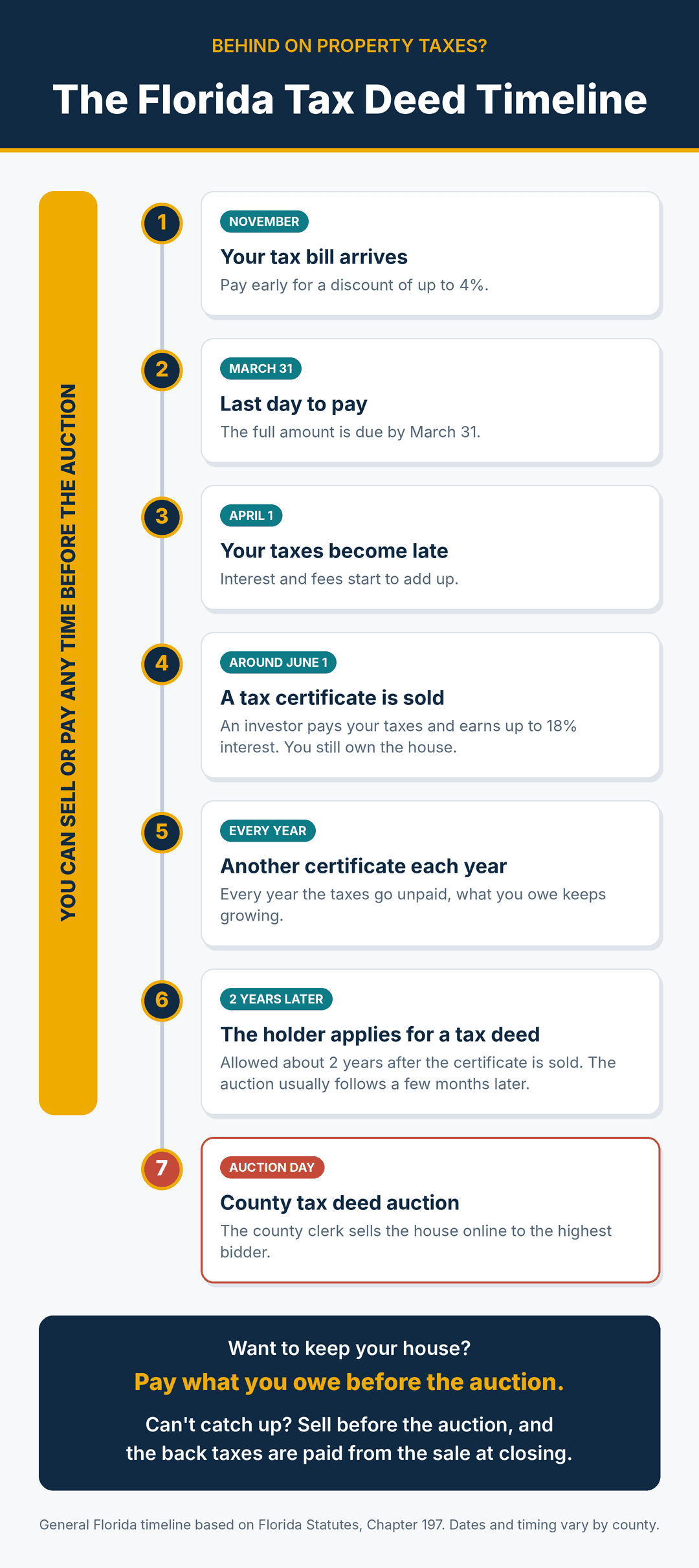
In Florida, the county doesn’t take your house the moment you miss a tax bill. It sells the debt to an investor first, and the house can be auctioned only after that investor has waited at least two years. Here is how it works, step by step:
- Your tax bill arrives in November. Florida property taxes are due on November 1. If you pay early you get a discount: 4% in November, then 3%, 2% and 1% in the months after. The full amount is due by March 31.
- The taxes become late on April 1. Under Florida law, unpaid taxes become delinquent on April 1, and interest and fees start to add up.
- The county sells a tax certificate, usually around June 1. A tax certificate isn’t a sale of your house. An investor pays your taxes to the county and, in return, earns interest on what you owe, bid at up to 18% a year. You still own the house. If no investor buys the certificate, the county keeps it.
- Each year you don’t pay, another certificate is sold. The amount you owe grows every year.
- After two years, the certificate holder can apply for a tax deed. Under Florida law, the holder can apply two years after April 1 of the year the certificate was sold. Applying is how the holder asks the county to auction your house to get paid.
- The clerk schedules a tax deed sale. You and anyone with a lien on the house are sent notice, and the sale is advertised. In Central Florida, the county clerk holds these sales online.
- The house is sold at auction. The highest bidder gets a tax deed to the house. Once the tax deed is issued, your right to pay and keep the house ends.
How long does it take? For example, if you didn’t pay your 2025 taxes, they became late on April 1, 2026, and a certificate was sold that June. The holder could apply for a tax deed starting April 1, 2028, and the auction usually follows a few months later. So most owners have well over two years from the first missed due date, but the amount owed grows the whole time.
Is your house a homestead? If your house has a homestead exemption, Florida law requires the opening bid at the tax deed sale to include half of the home’s latest assessed value, on top of the taxes, interest and fees. That makes the auction price higher, but it doesn’t stop the sale.
How to Stop a Tax Deed Sale
Pay what you owe before the tax deed is issued. Paying off a tax certificate is called “redeeming” it. Under Florida law, you can redeem a certificate any time after it’s sold and before a tax deed is issued. You pay:
- the unpaid taxes,
- the interest on each certificate (at least 5% of the amount, even if it was bid lower),
- a small fee for each certificate, and
- advertising and other costs.
Before anyone applies for a tax deed, you pay the county Tax Collector. Once a tax deed application has been filed, ask the Tax Collector or the Clerk of Court for the exact amount, because the application adds more costs. Either way, call and ask for a payoff amount in writing, good through the date you plan to pay.
Don’t wait for a payment plan. Florida counties generally don’t offer payment plans for taxes that are already late, so you’ll usually need to pay each certificate in full. For future years, ask your Tax Collector about the installment plan, which spreads next year’s taxes into four payments, and, if you are an older or lower-income homeowner, whether you qualify for a homestead tax deferral.
If you inherited the house, the taxes still have to be paid, even while the estate is being settled. Our guide for Florida heirs explains who can act for the estate and sign a sale.
If you can’t pay, sell before the auction. The next section explains how.
How to Sell Your House Before the Tax Deed Sale
Tax certificates don’t stop you from selling. You still own the house until a tax deed is issued, and the back taxes are simply paid off at closing, like a mortgage.
- Find out what you owe. Ask the Tax Collector, or the Clerk of Court if a tax deed application has been filed, for the amount needed to pay off every certificate and any current-year taxes. If there’s a mortgage, ask the lender for a payoff too.
- Find out what the house is worth as-is. Houses with years of unpaid taxes often need work too. Compare it with recent sales of similar homes nearby in similar condition. Our guide to selling a house that needs repairs explains how condition affects price.
- Check the calendar. If an auction date has been set, every week counts. Listing with an agent takes time: homes in the Orlando area averaged more than two months on the market in 2026, and a buyer’s loan then needs another 30 to 45 days to close. A cash buyer can close in one to three weeks.
- Close with a title company. The title search finds every tax certificate and lien. At closing, the title company pays the Tax Collector or the Clerk, pays off any mortgage, and if anything is left, it goes to you.
If an auction date is close, tell the buyer and the title company right away. If the sale to your buyer can’t close in time, paying off the certificates yourself, even with a short-term loan, can stop the auction and give the sale time to close.
What Happens if the House Is Sold at a Tax Deed Sale
The winning bidder gets a tax deed and becomes the new owner. The certificate holders are paid, along with the county’s costs.
If there’s money left over, it may come back to you. If the winning bid is more than what’s owed, the extra money is called surplus funds. Under Florida law, if there is a surplus, the Clerk of Court mails a notice to the former owner and to anyone with a lien. Government liens are paid first, then other liens such as a mortgage, and the owner gets whatever remains, if anything. In many cases there is no surplus at all, or liens use up most of it. If you receive a notice, you can file a claim with the Clerk yourself, using the form the Clerk sends you. Lienholders have 120 days from the notice to file, so file your own claim promptly.
Even so, an auction rarely works in your favor. The price is set by bidders, not by you, liens are paid before you, and if there’s any money left over, you have to claim it yourself. Selling before the auction almost always leaves you with more.
Watch out for unwanted offers. Once a tax deed application is filed, it’s public, and owners start getting letters. Be careful with anyone who:
- Offers to buy the house for a small fraction of its value because “you’re about to lose it anyway.” You’re not, as long as you sell or pay before the auction.
- Asks you to sign over your rights to the surplus funds before the sale, or charges a big fee to claim money you can claim yourself for free.
- Asks for money up front to stop the sale. Only the Tax Collector or the Clerk can take your payment.
If you sell, sell to a buyer who uses a written contract, closes through a local title company, and lets you take time to think. Our guide to selling off market for cash lists the questions to ask any cash buyer.
How House Solutions USA Helps
If you’re behind on property taxes and would rather sell than catch up, you can sell directly to us. We have been buying houses in Central Florida since 2013, and buying houses is our full-time business. When you sell to us:
- We buy the house ourselves, with our own money.
- We see the house once and give you a written offer within 24 to 48 hours.
- You sell as-is. No repairs, no cleaning and no showings. Leave behind what you don’t want.
- We work around your auction date. We have closed in 7 days, and a typical sale takes about 21.
- We pay all closing costs and charge no fees and no commissions.
- The title company pays the back taxes, any mortgage and any other liens from the sale money at closing, and if anything is left, it goes to you.
Call 407-738-1581 or fill out our cash offer form. To compare every way to sell, read ways to sell a house in Central Florida. We buy houses in Orange County, Seminole County, Osceola County, Polk County and South Lake County.
Frequently Asked Questions
Can I sell my house if I owe back property taxes in Florida?
Yes. You own the house until a tax deed is issued. The back taxes, interest and fees are paid from the sale money at closing, and if there’s money left over, it’s yours.
How long can property taxes go unpaid before I lose my house in Florida?
Taxes become late on April 1, and a tax certificate is usually sold around June 1. The certificate holder can apply for a tax deed two years after April 1 of the year the certificate was sold, and the auction usually follows a few months later. Most owners have more than two years from the first missed due date, but the amount owed grows every year.
Does a tax certificate mean someone owns my house?
No. A tax certificate is a lien. The investor who bought it paid your taxes and earns interest until you pay it back. You still own the house unless it’s sold at a tax deed sale.
How do I stop a tax deed sale in Florida?
Pay everything owed on the certificates before the tax deed is issued, through the Tax Collector, or the Clerk of Court once a tax deed application has been filed. You can also sell the house before the auction and have the taxes paid at closing.
What happens to the extra money if my house sells at a tax deed sale?
If the winning bid is more than what’s owed, the extra money is called surplus funds. The taxes, costs and other liens are paid first, and the former owner gets whatever remains, if anything. Often there is little or nothing left. If there is a surplus, the Clerk of Court mails you a notice and a claim form, and you can file the claim yourself.
Do I pay a commission or fees when I sell to you?
No. There is no agent commission and no fee to us. We pay the closing costs. You pay what you already owe on the house, such as the back taxes, any mortgage, HOA amounts and other liens, all from the sale money at closing.